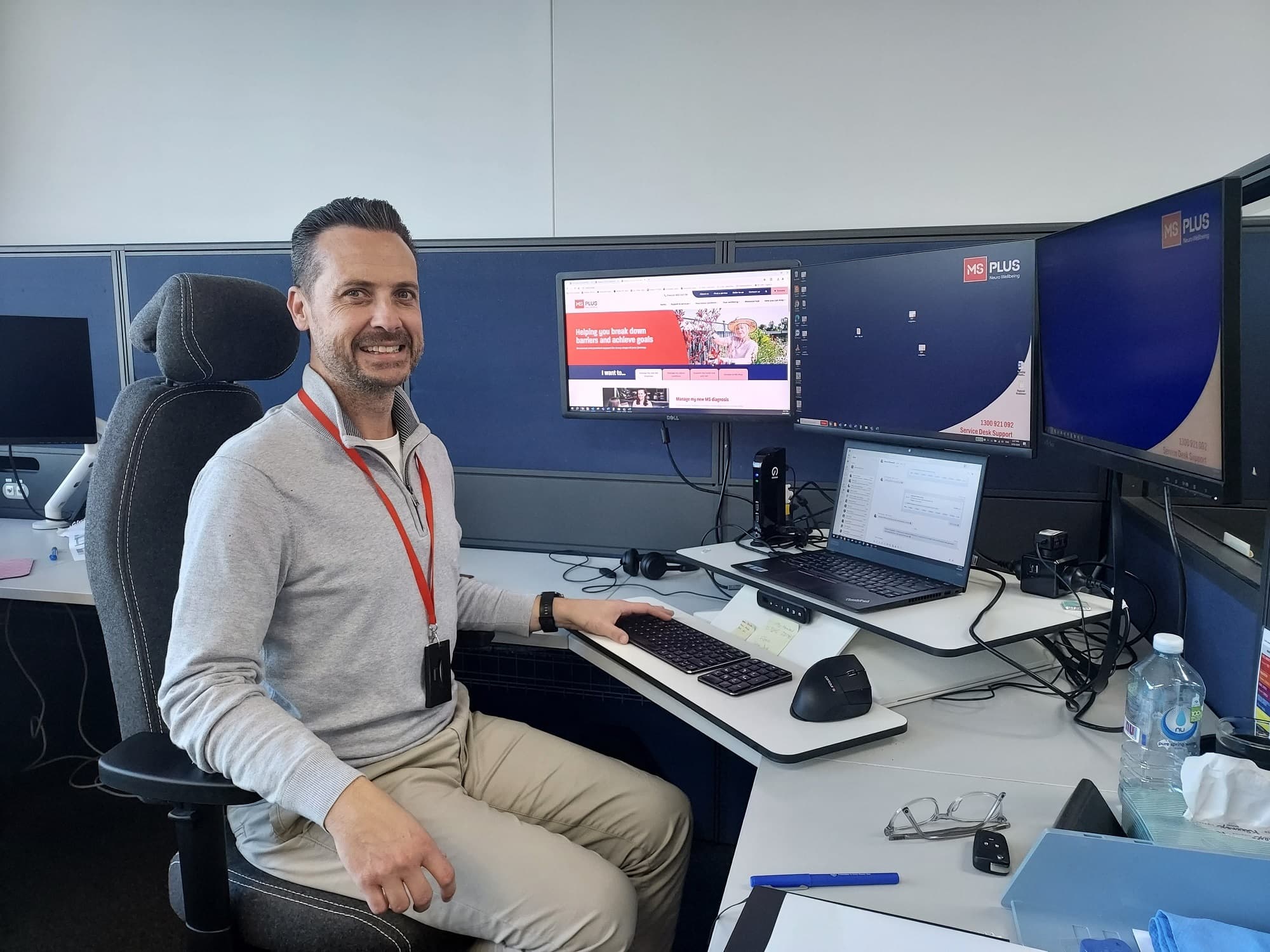
Brad had been feeling unwell for many years before being diagnosed with MS in 2020. After leaving his job in international trade in July that year, Brad went to an optometrist for a standard eye test. The optometrist flagged they may need to do some further investigation.
‘That’s how I was originally diagnosed with MS. Amid all the other stressors and change occurring in my life at the time, my diagnosis was really the lowest point for me,’ Brad says.
Brad’s symptoms include muscle spasticity and cramping and stiffness in his hips after periods of inactivity. He also experiences fatigue and cognitive difficulties.
‘My hips are a big issue in terms of seizing up if I’m sitting too long. My mobility is pretty good. I work on that every day, stretching etc. I try to keep moving as much as possible.’
Brad’s symptoms can make working at a desk for a full workday difficult without supportive intervention. After leaving his job in the finance sector and remaining unemployed while he focused on his health, Brad was keen to find the right role to get him back in the workplace.
‘I was completely lost for many years before I found out about my MS, but I soon realised that I needed to take ownership of my life and my body and not leave it up to someone else.’
Finding a new career path
Brad reached out to MS Plus early on, through Plus Connect. He was given information about the Employment Support Service (ESS) and put in touch with Employment Development Manager, Chris Kotsonis – who helped Brad to find a new role. He also works with an Occupational Therapist to help manage his symptoms and make sure they don’t impact his performance at work.
‘My OT helped by assessing and organising funding for specialised ergonomic equipment and now my set up at both my home and office are perfect for what I need. This helps me to manage my fatigue and my spasticity.
‘Having that weekly support with an OT, to run through any challenges during your week at work – I don’t think anyone can understand just how much that helps you. Exercise physiology, massage and other similar supports are just so beneficial for someone with any neuro condition.
‘It becomes about setting up these routines that help you to keep your daily life ticking along, which your OT can keep on track with as little as a 10 minute catch up,’ Brad says.
‘I know sometimes the idea of working full time can seem pretty tough if you have a chronic condition but if you can link into those resources that will continue to keep you in the workplace, it’s invaluable,’ Brad says.
‘A lot of people with MS probably don’t realise all these supports are available to them.’
After working in the finance sector again for a while, Brad realised his passions really lay in helping others. He reached out to Chris again later that year.
‘I told Chris what I really just wanted was to help people like me. He mentioned there might be a role available with the MS Plus Employment Support Service (ESS) team. I’ve now just reached the two-year mark with MS Plus.
‘Your MS is not nearly as scary as where your mind takes you initially. Understand that you control a lot of what you do from this point forward. Always ask questions and seek out information, it’s there waiting for you,’ Brad says.
‘MS was the trigger I needed to start my years of internal work rather than always looking to the world outside myself for answers.
‘Understand that you are in control of how you see things and how you approach the world and this can be changed as needed. If I’m unhappy, my life will become unhappy,’ Brad says.
‘Changing the way you look at yourself and being kind to yourself are so important.
‘From my point of view, MS is not a bad life, it’s just a bad day. Some days you just have to write off and say you’ll try again tomorrow.’
Related articles
Support to keep working: Santo’s story
Discover how MS Plus Employment Support Service has helped Santo stay employed for 30 years after his MS diagnosis through personalised workplace support.

- 19 October 2026
Your spring and summer wellbeing guide
Make the most of spring and summer with practical tips for managing heat sensitivity, staying active, conserving energy and supporting your wellbeing while living with MS or another neurological condition.

- 15 October 2026
Ask Nurse Amy: Staying cool and confident this summer
Learn why heat can worsen MS symptoms and discover practical strategies to stay cool, manage fatigue, stay active and enjoy summer with confidence.
- 14 October 2026