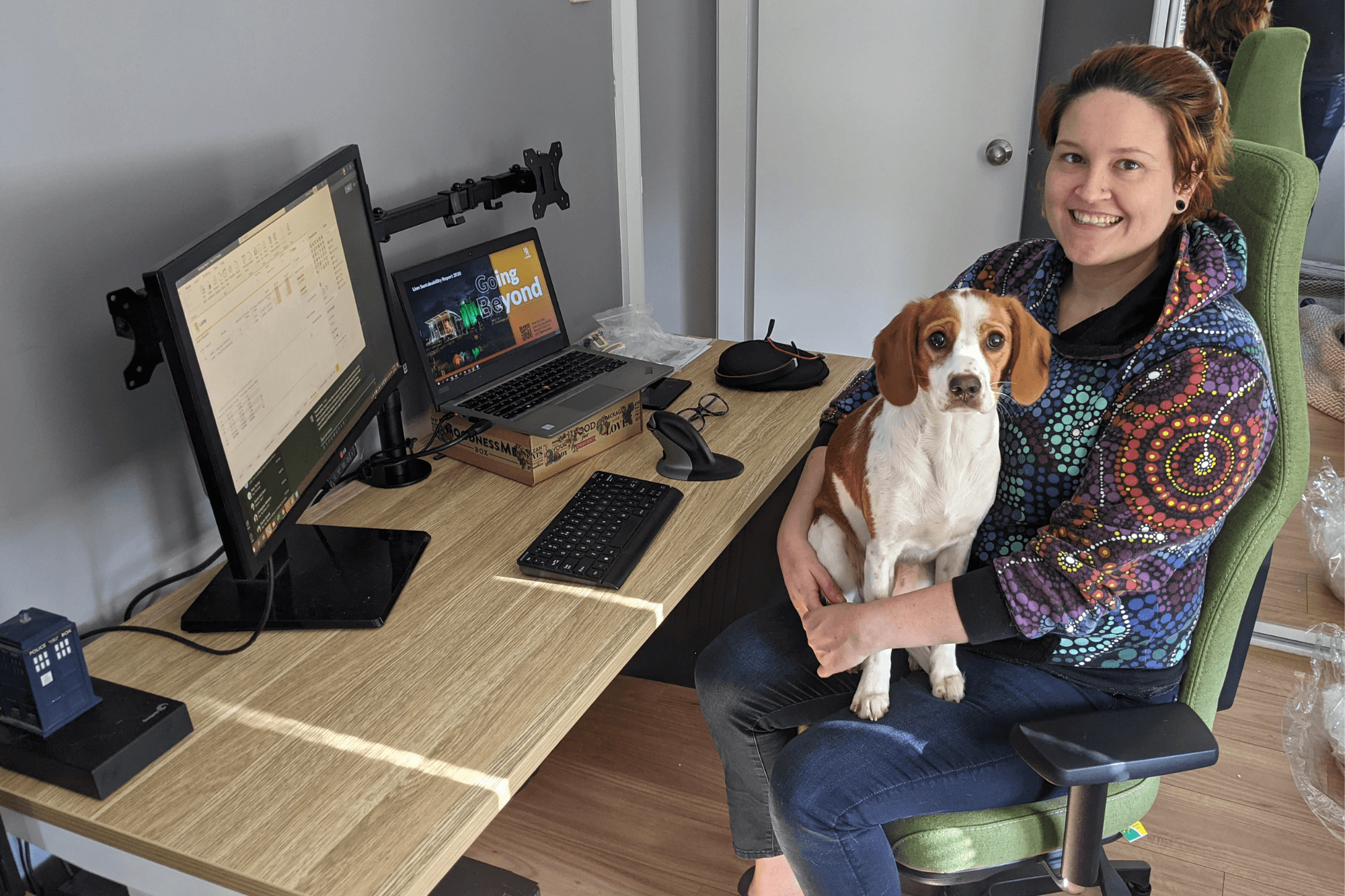
Not long after she was diagnosed with MS, during the middle of COVID lockdowns, Tamara started looking up the condition online. Beginning to feel frightened about what her future might hold, she reached out to MS Plus.
“I felt really lonely at first because no one I knew had MS and everybody made out like it was a bit of a death sentence and I started to become really scared. And of course I began Googling it, as you do when you’re newly-diagnosed, and I went down a bit of a rabbit hole,” Tamara says.
“I had been putting off reaching out for help for a while but after that I rang MS Plus. The staff member I spoke to was super kind and so patient and reassuring and she just made me feel so much less nervous about my diagnosis.”
Her contact at MS Plus initially put Tamara in touch with the Employment Support Service (ESS) and peer support.
“The Peer Support volunteer I spoke with was on the same treatment as me, and she made me feel less alone, and like my world wasn’t ending after all. Through MS Peer Support, I was also able to find a face-to-face group. My group meets regularly and it’s always nice to be surrounded by those who know what you’re going through, especially when life gets chaotic.”
“My employment support consultant, Kel, is great and she always makes me feel heard. I’ve never really had a problem disclosing to an employer or advocating for myself at work but without the support of my ESS Consultant, I wouldn’t have had the confidence or knowledge to know what I was advocating for.
“Kel always listens to my symptoms and gives me great advice about how to set up my environment at both work and home and I don’t know what I’d do without her.”
Tamara now has a set email she shares in a new workplace, explaining her MS and how her symptoms may impact her at work. For Tamara this means adjustments to her workstation, flexible work arrangements and being able to adjust the temperature in the office.
“My current employer is amazing actually, as soon as I started feeling more pain when in the office and I raised it with my leader, they jumped straight on it. Kel came out for an assessment and they asked her, even before her report was finished, what they could do immediately to make me more comfortable.”
Tamara also makes sure everyone at work recognises World MS Day and takes the opportunity to raise awareness and educate wherever possible.
“To me it seems like a no-brainer. It’s to everyone’s benefit to be flexible with staff who need it. I have so much to offer and that would all be lost if I had an employer unwilling to make concessions.”
At the start of her diagnosis, Tamara undertook the FACETS fatigue management course, which she credits with helping her to learn about prioritisation and scheduling, including for Tamara to manage how often she goes out at night.
“I went from being this very high energy, very active person always running around and doing things to feeling tired a lot of the time. Now I know I’m better during the day, and when to say no to things.”
Prior to her diagnosis, Tamara had been passionate about CrossFit and had played netball since she was eight, being active was an important part of her life but after her diagnosis, she was facing a reality where she may not be able to walk without a frame, let alone the ability to run on the netball court. Thanks to work with her Exercise Physiologist, she has begun to play again for the first time since her diagnosis.
“I was a very good netballer, but I never thought I'd be able to play again because I couldn't run. Working with my EP with my NDIS funding, I was able to get my reflexes to the point where I could get back on the court.
“My EP helps me by ensuring the movements I need to play are reflexive, rather than a conscious movement, like muscle memory. Thanks to regular EP visits, my muscles now engage better when I play, which means less falling over. I’m not quite back to where I was but it feels so good to be playing a sport I love.
“EPs are such a vital part of MS management, it’s really sad to hear that the NDIS may be defunding the service. It will mean a lot of people will miss out.
“MS Plus has done wonders getting me on to the NDIS in the first place as well. At first Annette had to help me kicking and screaming, as I really didn’t think I would qualify, but I was starting to use a cane more and then began looking at walkers.
“I was only 34 at the time and remember thinking, ‘wow I really shouldn’t be looking at walkers’. Annette talked me down, followed up all my paperwork and in the end, I was approved first go. I know this wouldn’t have happened without her help. Being on the NDIS has also changed my life. I don't even need to use my working cane anymore.
“All the support I have accessed so far has really helped me to live the life that I want, to keep working and to get back to the things I love. My advice to anyone newly diagnosed is that you don't have to struggle alone. The help you need is all in one place. make sure you call; it's a life changing call.”
Tamara says it’s equally important for carers to access the support they need.
“Carers, family and friends should make the most of the support on offer. Connecting with peers, connecting with people going through and experiencing the same stuff as you will help you learn how to deal with the situation, but it also helps you get through your grief as well, because everyone focuses on the patient.
“My husband and I were getting married the year I was diagnosed. I got diagnosed in May and we were getting married in September and there was a point where he almost had to grieve and to adjust what he thought our lives were going to look like. He of course had had a vision for what our married life would be and that did change somewhat.
“I think working through this change together with someone is really important because it's not just the person with MS whose life changes, it impacts their family too.”

Help ensure no one faces MS alone
When Tamara was first diagnosed, a call to MS Plus connected her with the information, support and community she needed to move forward with confidence.
Today, your support can help ensure others facing a new diagnosis can access the same guidance, connection and care when they need it most.
If Tamara's story has resonated with you, please consider supporting our Spring Appeal.
Related articles
Finding purpose through peer support: Matt's story
After receiving support from MS Plus following his MS diagnosis, Matt now gives back as a volunteer, creating connection and support for other men living with MS.
- 24 October 2026
Support to keep working: Santo’s story
Discover how MS Plus Employment Support Service has helped Santo stay employed for 30 years after his MS diagnosis through personalised workplace support.

- 19 October 2026
Your spring and summer wellbeing guide
Make the most of spring and summer with practical tips for managing heat sensitivity, staying active, conserving energy and supporting your wellbeing while living with MS or another neurological condition.

- 15 October 2026