“When I was first matched with Rosi for a one-on-one phone chat, I was initially disappointed that she was based in Sydney, while I’m in Hobart, but it actually never mattered at all!” Nicole says.
Nicole and Peer Support Facilitator Rosi hit it off immediately – so much so that they decided to meet up in Victoria to see an art exhibition.
“We did our usual initial six calls that you get with the Peer Support phone support service, but then just decided to keep going! We talk about every six to eight weeks and it has been wonderful,” Nicole says.
“At one point we were talking about art, something we both like, and found out we were both headed to this once in a lifetime art exhibition in Victoria and so we decided to meet up!
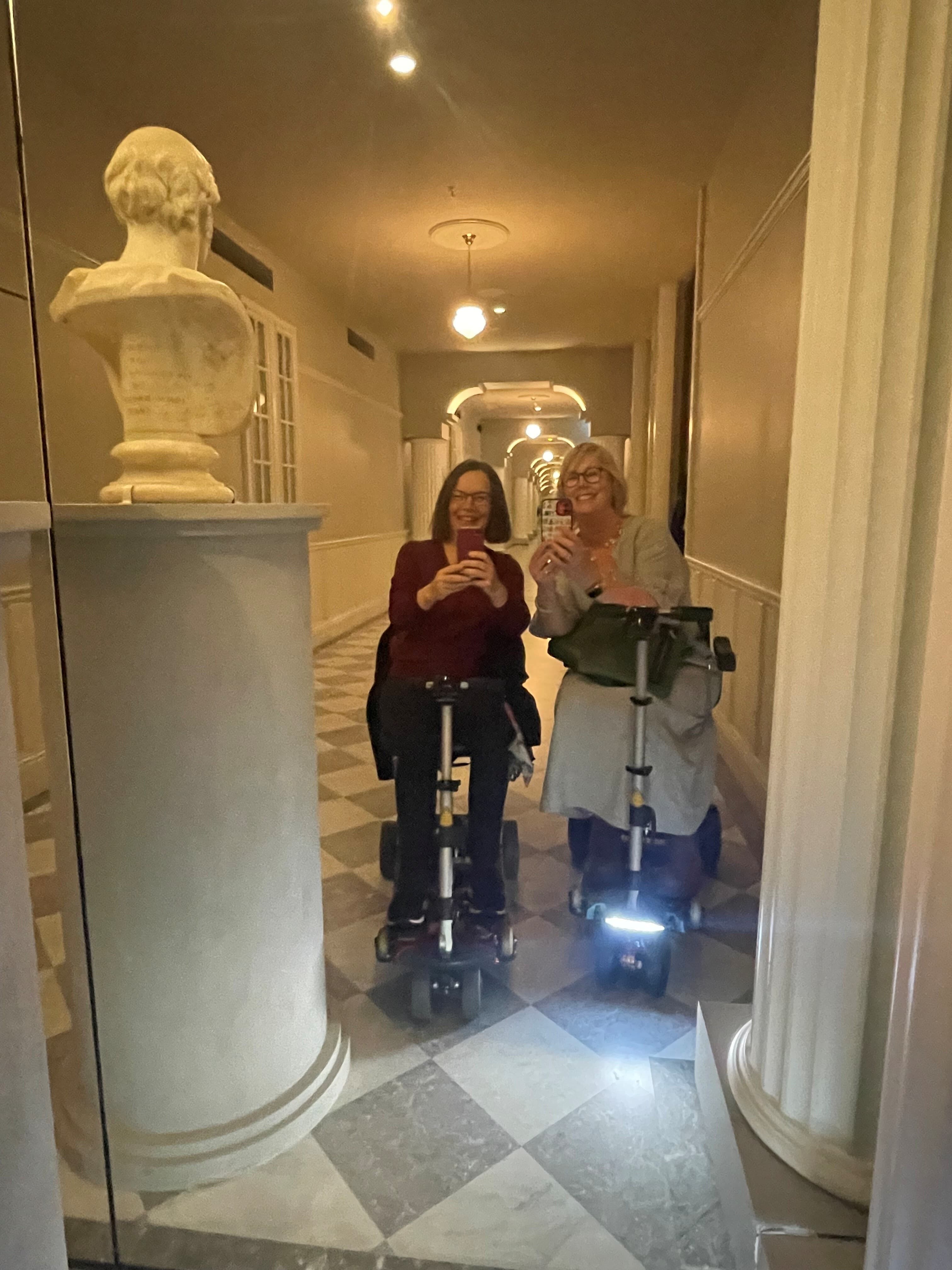
“It was so much fun. I had recently bought a mobility scooter, which I hadn’t used before, I usually use my walking stick whereas Rosi uses her scooter frequently. We talked about how Rosi was taking her scooter on the trip, and I thought it might be a good time to be brave and use mine.
“We just laughed our heads off the whole time. We were both so silly, it was like two young school girls meeting up for the first time who have only ever been pen pals! There was no awkwardness, we just got along instantly,” Nicole says.
Diagnosed with MS in 2013, Nicole reached out to MS Plus and was connected to occupational therapy and exercise physiology. MS Plus also helped Nicole to access the NDIS, which enabled her to access all the help she needed, including help with gardening and cleaning.
“MS can be the most overwhelming diagnosis. I had visions of myself in a wheelchair within days and that I would fall apart but I soon learned that it’s not the case. The sooner you reach out for help, the better and because the staff at MS Plus are experts in MS they know exactly what’s good for you and what will work specifically for you.”
Nicole was also connected to Employment Support Services (ESS) while attending a Peer Link – three or four weekly sessions where a peer support coordinator facilitates discussions with guest speakers.
“I’m a teacher and my OT arranged for a special desk, chair and screen for home. Employment Support Services all help me to get a special chair at work, a new screen and file holders to save me having to hold documents myself, to help lessen the fatigue, which has helped enormously. At the end of the last school term I took early retirement, but I stayed a lot longer than I would have otherwise if I hadn’t had that help,” Nicole says.
Of her time in Peer Support, Nicole says to just give it a shot and be patient finding the right fit for you.
“I’m so glad I was matched up with Rosi. The Peer Support team work hard to match their volunteers with people they think have a lot in common. They ask a lot of questions and really get to know you first, but I would also say don’t lose heart if the first group or person you’re matched with doesn’t quite work out. It’s not an exact science and sometimes just takes a bit of trial and error.
“What I love about having someone like Rosi to chat to is that you’re talking to someone who really gets what it’s like to live with MS, you hardly have to explain anything. Instead of people saying ‘oh but you look so well!’ she just understands, which is why the peer support is great.
“You don’t need to think about how or if to disclose to someone. She’s also had MS longer than me, she has lots of little tricks and tips that have worked for her.
“There’s no judgement, so much information comes out of the peer support experience but now I also have a great friendship as well. It’s all about finding your people.”
To find out more about Peer Support phone 1800 042 138 or email connect@msplus.org.au
Pictured: Rosi (left) and Nicole at the National Gallery of Victoria
Related articles
“You don't have to struggle alone. The help you need is all in one place”: Tamara’s story
“I had been putting off reaching out for help for a while but after that I rang MS Plus. The staff member I spoke to was super kind and so patient and reassuring and she just made me feel so much less nervous about my diagnosis.”
- News
- 29 March 2026
“When I finally got answers I thought, now that I know what it is, I can do something about it": Jemma’s story
When Jemma Rose was diagnosed with MS in 2022, her first reaction was relief. Finally, there was an explanation for many of the medical issues she’d been experiencing.
- News
- 18 March 2026
A place that feels like home: helping Beth reclaim confidence and mobility
Beth was diagnosed with MS in 2007 and has a long-standing goal to improve her core strength to reduce pressure on her legs and maintain her mobility as much as possible. She was at a bit of a loss when her previous exercise physiologist retired, until Beth was encouraged to visit MS Plus and the Hobart Wellbeing Centre, which offers a neuro friendly gym and a range of tailored services under one roof.
- News
- 9 March 2026